Address
304 North Cardinal
St. Dorchester Center, MA 02124
Work Hours
Monday to Friday: 7AM - 7PM
Weekend: 10AM - 5PM
Address
304 North Cardinal
St. Dorchester Center, MA 02124
Work Hours
Monday to Friday: 7AM - 7PM
Weekend: 10AM - 5PM

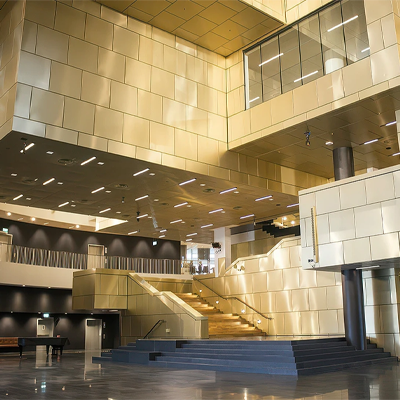
The construction industry is undergoing a comprehensive upgrade from traditional materials to modern technological materials. With accelerating urbanization, continuously improving aesthetics, and increasingly stringent green building standards, building materials not only need to meet aesthetic requirements but also demands lightweight construction, structural safety, and environmental recyclability. Metal decorative materials, especially aluminum single-panel and aluminum honeycomb panels, are gradually becoming an important component of modern architecture.
Lightweighting is a crucial trend in future construction. In large-scale projects such as high-rise buildings, public facilities, and transportation hubs, the use of lightweight materials not only reduces structural load but also improves installation efficiency and safety. Aluminum single-panel panels are inherently lightweight and high-strength, while honeycomb panels take “lightness” and “stability” to the extreme. The hexagonal mechanical principle of the honeycomb structure gives it higher strength while remaining lightweight, making it less prone to deformation and ideal for large panels or outdoor curtain walls.
Durability is also a key focus in modern architecture. Traditional paints or decorative materials are prone to fading and aging, while high-quality fluorocarbon-coated aluminum single-panel panels have strong UV resistance and corrosion resistance, with an outdoor service life of over 20 years. For public spaces with high daily foot traffic, such as airports, high-speed rail stations, and subways, durability, safety, and ease of maintenance are paramount.
Sustainability is an inevitable trend in the global construction industry. Aluminum is a recyclable material with an extremely high recycling rate, meeting the environmental requirements of green building standards. With the global adoption of ESG principles, more and more developers and international brands are using “material environmental friendliness” as a key criterion for supply chain selection. Metal decorative materials are therefore becoming a more future-oriented choice.
Meanwhile, spatial aesthetics are constantly evolving. Architecture is no longer a cold, functional entity, but a space that carries culture, experience, and brand value. The plasticity of metal materials allows for more innovative shapes: large curved surfaces, wave-like forms, openwork patterns, gradient decorations, etc., allowing buildings to present different visual effects from different angles, creating a more layered and modern feel.
Advances in intelligent manufacturing technology have also driven industry development. Advanced CNC machining centers, automated bending equipment, and intelligent spraying lines have made complex shapes and mass customization possible. Companies like Yanlai Building Materials have adopted automated production processes, which have improved precision and shortened delivery cycles, enabling large-scale projects to proceed more efficiently.
From urban landmarks to everyday public spaces, from commercial complexes to residential projects, the application of metal decorative materials is becoming increasingly widespread. It is not only changing the appearance of buildings but also influencing how we experience future spaces. It is foreseeable that in the next decade, lightweight, durable, and sustainable metal decorative materials will continue to lead architectural design trends and become a vital force in creating modern architecture.
